ABOUT
The Tribes
Discover the Amazonian tribes we work with
At Make It Sacred we are honoured to work directly with a number of Indigenous communities from the Amazon. We work with medicine men and women from the Yawanawá, Katukina, Kuntanawa, Nukini, Huni Kuin, and Caboclo peoples.
The Apurinã
The Apurinã are an Indigenous people of the Brazilian Amazon, living along the banks of the Purus River. Known for their deep connection to the forest and their sacred green snuff, Awiry, they maintain a vibrant spiritual life and ceremonial tradition while continuing to defend their ancestral lands.
The Apurinã live scattered along the banks of the Purus River, sharing a rich cosmological and ritual culture rooted in their natural environment. Their language belongs to the Aruak linguistic family, with the closest related language being that of the Manchineri, who inhabit the Upper Purus basin.
The Apurinã are especially known for their green snuff called Awiry. This plant holds immense cultural and spiritual value, so much so that other tribes refer to them as “the People of the Awiry.” Awiry is the primary plant used by Apurinã Pajés (shamans) to diagnose illness and perform healing.
The tribe’s history is deeply marked by the violence of the two rubber booms in the Amazon region. Today, they continue to fight for the recognition of their ancestral lands, some of which are still unacknowledged and regularly invaded by loggers. The Apurinã inhabit 27 Indigenous territories at varying stages of official recognition. About 20 of these areas have been fully demarcated and registered, but the struggle for land rights remains ongoing. The tribe comprises approximately 9,500 members, who are spread across the states of Acre, Amazonas, and Rondônia.
Explore their Medicine

The Caboclo
The Caboclo people represent the colourful integration of Indigenous traditions, African culture, and European heritage. Their identity is not merely a sum of distinct ancestries, but a unique cultural synthesis — something entirely new. The Caboclo tradition represents a unique fusion of Indigenous, African, and European spiritual influences — a living expression of forest mysticism, born during the Amazonian rubber boom and carried forward by communities who maintain strong spiritual relationships with the land.
The term Caboclo (or Caboco in regional dialect) traditionally refers to people of mixed Indigenous Brazilian, African, and European (primarily Portuguese) ancestry, especially those living in the Amazon forest. They are often associated with rural or forest communities in the Amazon basin, where Indigenous lifeways are still preserved. While the term can carry pejorative connotations in mainstream usage, within spiritual and cultural contexts, Caboclo is a name of respect, wisdom, and identity.
The Caboclo identity emerged during colonial times, as Indigenous peoples were forced out of their homelands and intermarried with African slaves and European settlers. Their descendants lived at the intersection of two worlds, embodying both resistance and adaptation. In contemporary times, many identify as Caboclos not racially, but culturally — meaning one may be called a Caboclo for living a forest-based, Indigenous-aligned lifestyle, regardless of ancestry. As such, they represent both spiritual guardianship and political resistance, especially within movements defending Amazonian culture and land rights.
Etymologically, Caboclo can be interpreted to mean “inhabitant of the forest”. They are often farmers, fishermen, hunters — and, in many cases, keepers of timeless forest knowledge passed down through generations.
In Brazil, particularly in the northern state of Amazonas, an entire day is set aside to honour their rich legacy. June 24th is celebrated as Dia do Caboclo, a tribute to their vital contributions to Brazil’s cultural mosaic.
In Umbanda, a spiritual tradition rooted in African, Indigenous, and European elements, the figure of the Caboclo is revered. Spiritually, Caboclos are seen as Indigenous warrior spirits, healers, and hunters — often associated with Oxóssi, an orixá (deity) of the forest. These entities are invoked in rituals for their clarity, humility, and strength — uniting human vitality with the primal force of nature.
The people known as Caboclos are the living expression of syncretic history — a deep fusion of Indigenous, European, and African lineages shaped in the post-colonial Amazon. This cultural crossover extends into their snuff (Rappé) crafting, where the flavours, energetics, and ancestral techniques converge. Their blends are known for their strength, balance, and exceptional quality — a direct reflection of their diverse roots.
Explore their Medicine


The Huni Kuin
The Huni Kuin (also known to others as: Kaxinawá, Cashinahua, Kaschinawa, Kashinawa, Caxinauás) are an indigenous people of Brazil and Peru. Huni Kuin means “The Real People” in the native tongue – and their entire culture is connected to the rainforest. They have ancient knowledge about the healing power of plants and social cohesion; they live in harmony with nature and as inhabitants of the forest.
Their villages are located along the Purus and Curanja Rivers in Peru and the Tarauacá, Jordão, Breu, Muru, Envira, Humaitã, and Purus Rivers on the Brazilian side. In the Peruvian Amazon rainforest, some Huni Kuin live on the Alto Purús Indigenous Territory with the Kulina people.
The Huni Kuin dialect is a Panoan language called Hancha Kuin, meaning ‘Real Words’. It is estimated that only 5% to 10% of the Huni Kuin in Peru speak Spanish and literacy rates are low.
The history of the Huni Kuin is marked by profound suffering, beginning with their first contact with Western civilisation around a century ago. During this time, they endured forced labour, displacement, and genocide. Today, they continue to face racism, poverty, and the ongoing destruction of their forest habitat driven by human greed. More and more pieces of forest are falling victim to fire or are being cut down to make room for cattle and soy plantations.
One solution to protect their culture and the forest was to acquire their own land. They are one of the first indigenous Amazon peoples to have already purchased their own land. The Huni Kuin want to continue with this. By acquiring land, they are strengthening the association of indigenous territories that exist in the region. Although this may not sound like a big deal to most westerners, it is a huge paradigm shift for the indigenous peoples of the Amazon to consider “owning the earth”.
The Huni Kuin are excellent musicians and have a deep knowledge of the jungle. The Huni Kuin use Rappé for a wide range of purposes from physical healing, mental healing, to heighten concentration, improve hunting skills and connection to Spirit and ancestors. The Huni Kuin love to experiment and use a wide range of ingredients for their snuffs.
Explore their Medicine


The Katukina
Defining who the Katukina are based on their name alone is not a simple task. Since the first half of the 19th century, the historical records produced by missionaries, travellers, and government agents concerning the indigenous peoples of Juruá River refer to all the known indigenous groups by the name ‘Katukina’.
According to the anthropologist Paul Rivet: “Katukina or Catuquina, Katokina, Katukena, Katukino — is a generic term that came to be attributed to five linguistically distinct and geographically proximate groups” (Rivet 1920). Today, this number has been reduced to three, further divided into six clans: one from the Katukina linguistic family in the region of the Jutaí River in Amazonas state, and two from the Pano linguistic family in Acre state.
The name ‘Katukina’ is not the name each of the tribes use for themselves; rather, it is a designation they accept as an overall definition for the six clans. There is no single common ethnic designation; instead, there are self-designations that are widely accepted and refer to the six clans into which they divide: Varinawa (People of the Sun), Kamanawa (People of the Jaguar), Satanawa (People of the Otter), Waninawa (People of the Peach Palm), Nainawa (People of the Sky), and Numanawa (People of the Dove).
This group of people — designated the Katukina — remains deeply connected to their traditions and are well known for their knowledge and use of sacred plants. They consider themselves the first people to receive Kambo medicine directly from the frog. Katukina Rappé is known for its strength and depth, carrying the wild, intimate spirit of the jungle.
Explore their Medicine


The Kuntanawa
The Kuntanawa call themselves the ‘People of the Coconut Palm Fruit’, or the ‘People of the Stars’. After surviving near extinction during the rubber boom, they have re-emerged to reclaim their land, language, and spiritual traditions rooted in deep connection with the medicine of the forest.
The Kuntanawa are an Indigenous people from the State of Acre in Brazil, living in the Alto Juruá Indigenous Reserve along the Tejo River, in the municipality of Marechal Thaumaturgo. They reside in the villages of Kuntamanã and Seven Stars, with a total population estimated at around 400 tribespeople.
At the beginning of the 20th century, the Kuntanawa almost became extinct due to persecution by the rubber tappers. For almost a century, the tribe stayed off the map of the government. All were thought to have been wiped out by genocide. At the turn of the century, the tribe miraculously resurfaced from living a life of quiet solitude to claim their rights and land. The tribe has always attributed the principle of their existence to their spiritual tradition. The Kuntanawa have a long and vibrant tradition of using the forest and its plants to connect to Spirit and healing forces, and to this day maintain a strong cultural tradition of healing.
They have a wonderful variety of Shamanic Snuffs – Rappé – offering a wonderful variety of essences, flavours, and uses. The Kuntanawa use Rappé to empower their intentions and healing abilities, and to connect with the spirit world.
Explore their Medicine


The Nukini
The Nukini are an Indigenous people of the Brazilian Amazon, belonging to the Pano linguistic family and rooted in the Juruá Valley region. Despite a history marked by exploitation and violence during the rubber boom, they continue to preserve their cultural identity through spiritual practices, sacred medicines, and deep ties to the forest.
The Nukini form part of the group of Pano-speaking peoples that inhabit the Juruá Valley region, sharing both similar ways of life and worldviews. This includes a devastating history of dispossession, violence, and exploitation since the mid-19th century at the hands of the rubber barons.
Amid great resistance during the first Amazonian rubber boom, the Nukini of Brazil settled in a region of the Amazon that includes the Juruá and Serra do Môa. Traditionally, the Nukini were organized into small clans: Inubakevu (People of the Jaguar), Papabakevu (The Açaí People), Itsäbakevu (People of the Potoá), and Shãnumbakevu (People of the Cobra).
Today, the Nukini are united in a movement to strengthen their traditions through the revitalization of their spirituality, customs, handicrafts, and sacred medicines — including their highly valued Rappé.
Explore their Medicine


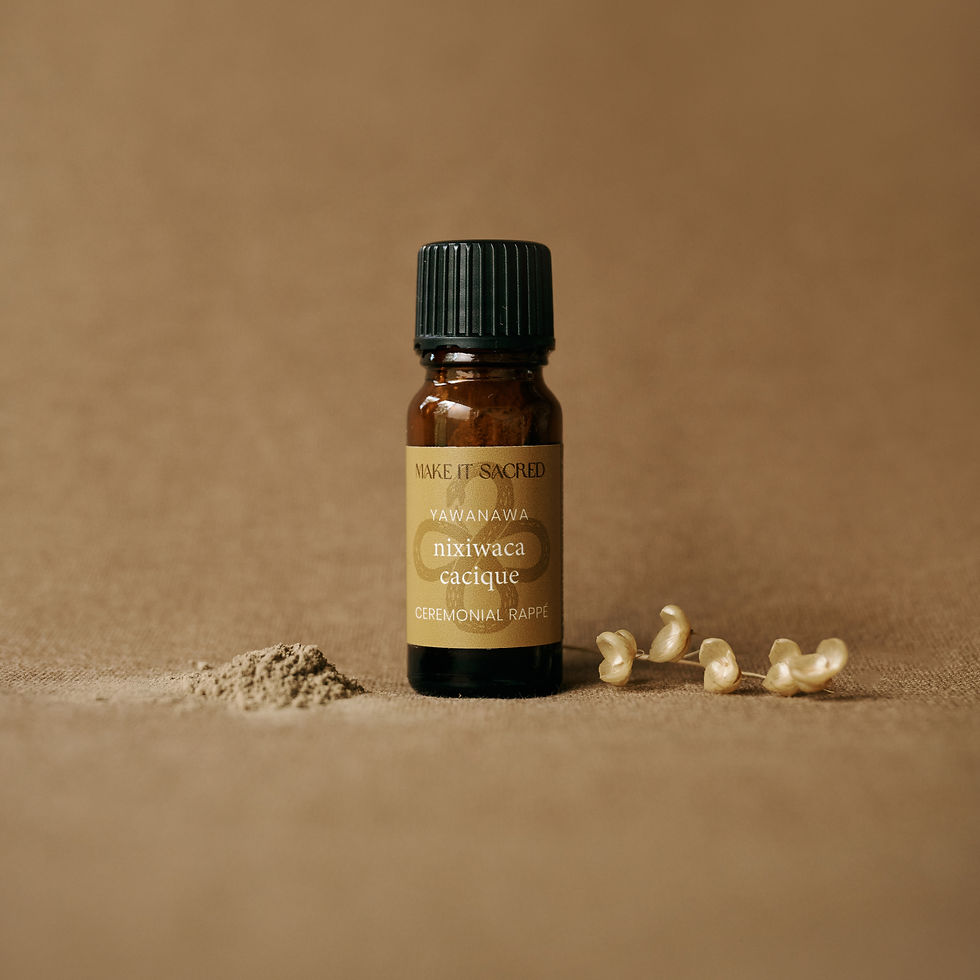
The Yawanawá
The Yawanawá people are a small group with an estimated 1,300 residents living in villages along the Gregorio River. They have always been associated with warriors known for their excellent sword skills. Like most tribes in the Amazon, they were close to extinction, with only an estimated 300 members remaining after the first rubber booms in the late 19th century. Today, the group continues to grow and preserve their strong spiritual principles within a tightly-knit community.
The Yawanawá are believed to be one of the first tribes to initiate women into the role of Pajé (shaman), and they have a rich history of powerful medicine workers. In the Yawanawá language, Rappé is called Rumè or Rumã. The Yawanawá are exceptional snuff makers, often blending it with Tsunu, creating sophisticated and unique mixtures. These powerful Tsunu blends are frequently used during Ayahuasca ceremonies.
The Yawanawá have a profound understanding of their shamanic system, which is passed down through initiates and shamans. The study of Yawanawá spirituality begins with prayers, special diets (dietas), and intense initiation processes. Among their sacred medicines, Rumé or Rumã holds a central place in their culture. Rappé has an ancestral legacy of healing that has existed since time immemorial, deeply woven into their cosmology as reflected in their stories and myths.
Explore their Medicine